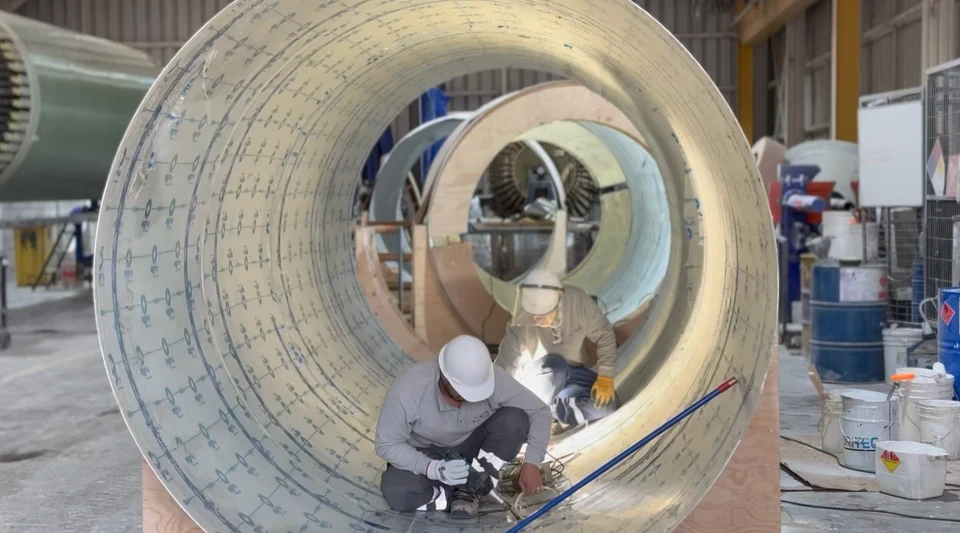
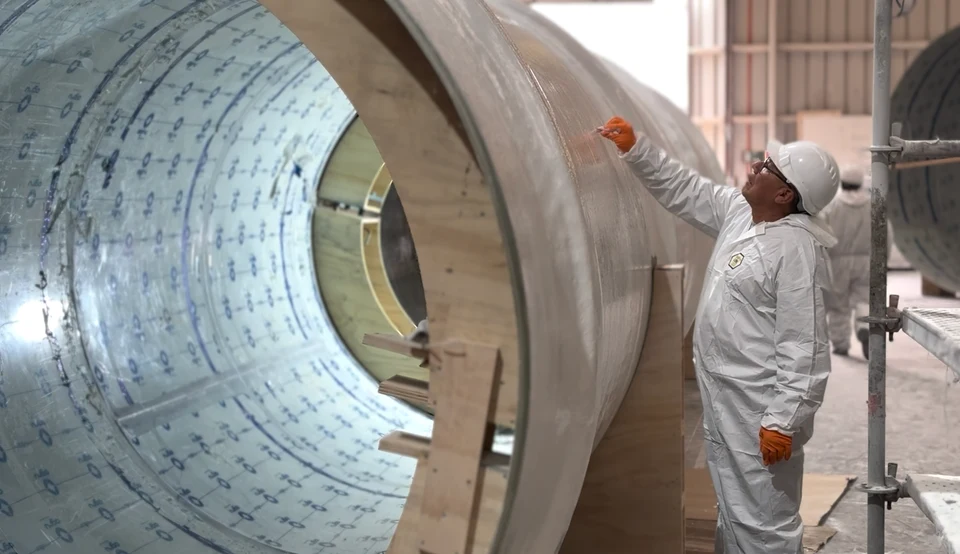
Workers performing tasks inside a large-diameter FRP duct section.
Two materials, one single construction system
In a dual laminate configuration, the thermoplastic liner faces the medium and the FRP structure provides strength and stiffness. Performance depends on selecting the thermoplastic, defining the bond between layers, fabricating and welding correctly, solving the field joints and inspecting the continuity of the system.
Dual laminate is not automatically superior to FRP. It is evaluated when chemical and thermal conditions justify separating the barrier from the structural element, and when fabrication, inspection, repair and life-cycle cost support the decision.
Variables that define a dual laminate configuration
Each variable determines a design, fabrication or inspection decision. Operating ranges and service life are defined for the specific medium, its concentration and the actual operating regime.
Medium, concentration, contaminants and expected permeation.
Determines the candidate thermoplastic and the compatibility verifications required.
Normal temperature, variations and cycles.
Determines the barrier system and the design margin against peaks or regime changes.
Candidate thermoplastic and joining method.
Determines whether the configuration is technically viable with the procedures that will be applied to the case.
Adhesion or integration between liner and structure.
Determines the load transfer and the constructive continuity between the barrier and the backing.
Pressure, vacuum, external loads and geometry.
Determines thicknesses, reinforcements, stiffening rings and structural verifications.
Shop and field joints.
Determines the fabrication and installation sequence and the critical inspection zones.
Access for inspection, barrier continuity and repair.
Determines the feasibility of maintaining the system over its service life.
Candidate barrier materials
The barrier is selected according to the medium, the temperature and the equipment configuration.
01PVDF
02PP
03ECTFE
04The selection of the thermoplastic depends on the medium, its concentration and the operating temperature.
What Invenio can do on dual laminate equipment
The fabrication and inspection of dual laminate have their own requirements, different from those of an FRP laminate.
Scope
Engineering: selection of the barrier system, sizing of the structural backing and drawings.
Fabrication of tanks, ducts and equipment combining a thermoplastic barrier and an FRP structure.
Field installation, with the joints the system admits.
Repair and intervention of dual laminate equipment in service.
Inspection of the continuity of the barrier and of the structural laminate.
Inputs we need
Medium, with its concentration and known variations.
Operating temperature and its peaks.
Pressure or vacuum regime of the system.
Geometry, dimensions and interfaces with the rest of the plant.
Which alternatives were already discarded and why, if the client made that assessment.
Deliverables
Written system selection criterion, with the alternatives compared.
Calculation report for the structural backing, with its assumptions declared.
Fabrication and installation drawings.
Fabrication control records and barrier verification records.
Limits
The compatibility of the thermoplastic is defined with the concentration, the temperature and the operating regime of the medium.
The joining techniques are defined together with the fabrication, the installation and the inspection of the system.
Repairing a thermoplastic barrier in the field requires specific conditions and is assessed case by case.
Dual laminate is not an automatic improvement over FRP: when FRP solves the case, we propose FRP.
Visual record
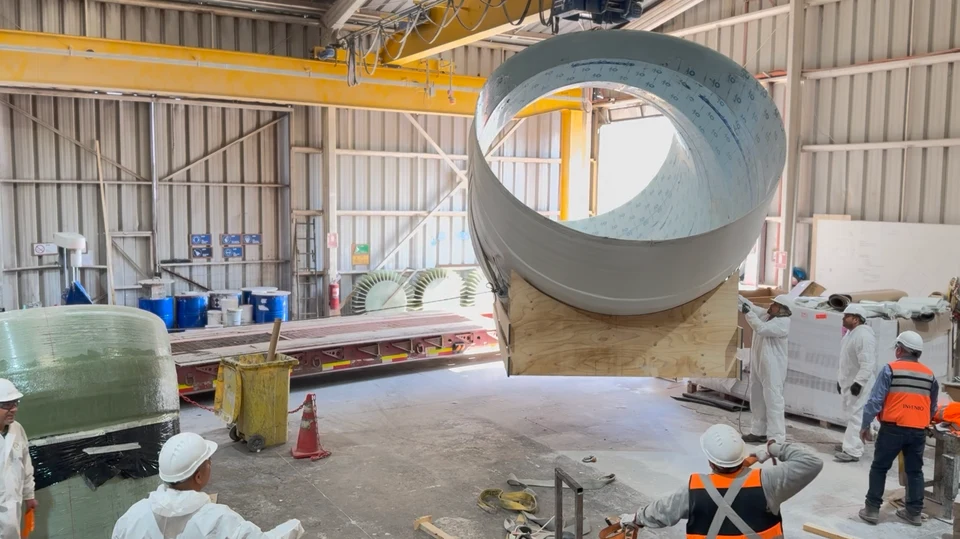
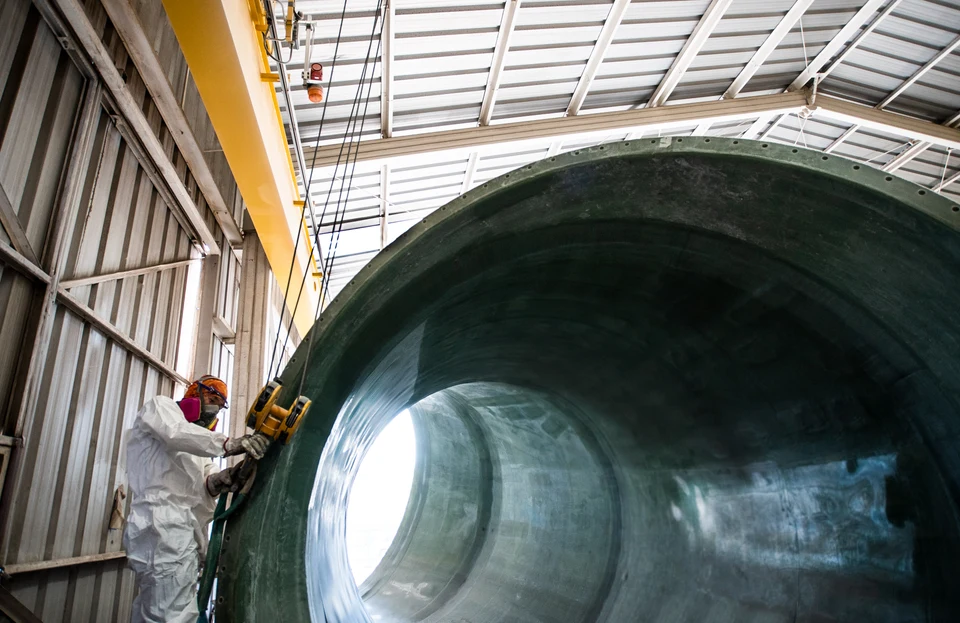
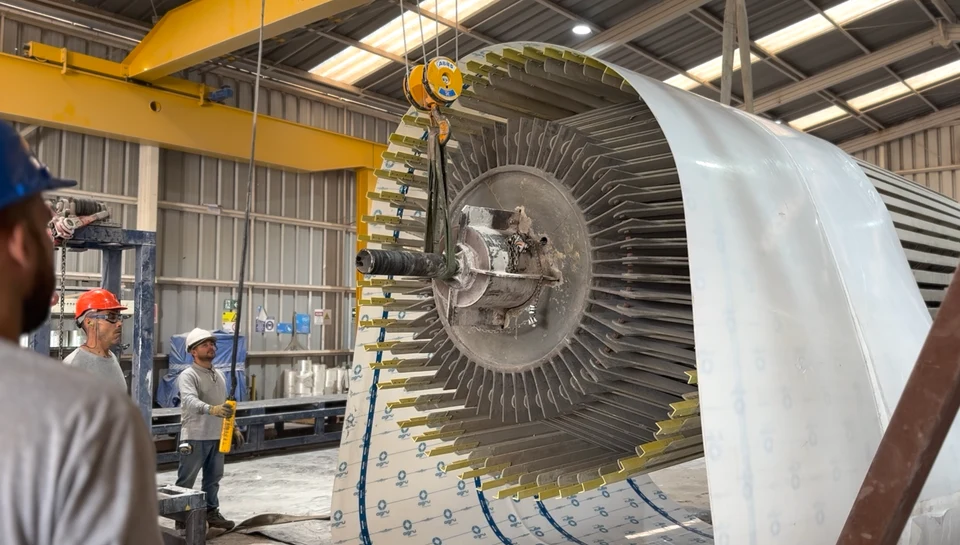
Descriptive photographs of laminate and interior finishing on FRP equipment. They do not document any particular dual laminate system.
Enlarge imageClose image
Workers performing tasks inside a large-diameter FRP duct section.
Send the medium, the composition, the temperature, the pressure or vacuum, the geometry, the material currently under evaluation and the fabrication or installation constraints.